Towing Guidelines
In the event that your vehicle needs to be towed, please follow these guidelines:
- There is nothing that disengages the drive wheels from the elective motor so the rear wheels should never exceed 25 miles per hour. AC drive motors are more forgiving but say in the case of a DC drive motor the windings will stretch at high motor speeds resulting in the motor locking up. This can in turn break the rear axle. It's just a good idea to either keep speed below the 25 miles per hour, tow with the rear wheels lifted or in best cases tow vehicle on a flatbed.
- Ignition key should be in the off position. As another level of safety, the main battery disconnect switch can be turned off.
- Vehicle does not have tow hooks. For low-speed short distance towing you will want to attach to components securely bolted to the center tunnel. Tunnel runs most of the length of the vehicle.
- There is no mechanism to disengage the drive wheels from the electric motor. As a result, the rear wheels should never exceed 25 miles per hour while towing.
- AC drive motors are more forgiving; however, with DC drive motors, excessive speeds can cause the windings to stretch, potentially resulting in motor lock-up. This may also lead to rear axle damage.
- It is strongly recommended to: keep towing speeds below 25 mph, tow with the rear wheels lifted, or use a flatbed (preferred method)
- The ignition key should be in the OFF position during towing.
- For additional safety, the main battery disconnect switch should be turned off.
- This vehicle is not equipped with tow hooks. For low-speed, short-distance towing:
- Attach to components securely bolted to the center tunnel.
- The center tunnel runs most of the length of the vehicle
Transport Guidelines (Trailer or Enclosed Transport)
When transporting the vehicle over longer distances (e.g., via trailer or enclosed semi-trailer), please note the following:
Vehicle Dimensions:
- Width: 65 inches (mirrors folded)
- Length: 156 inches (bumper to bumper)
- Height: Typically allow 80 inches, though this may vary depending on configuration and loading angle
- Track width (center of wheels, side-to-side): 50 inches
- Wheelbase (center of wheels, front-to-back): 102 inches
- Weight: varies based on configuration: 1,600–3,000 lbs
Securing the Vehicle
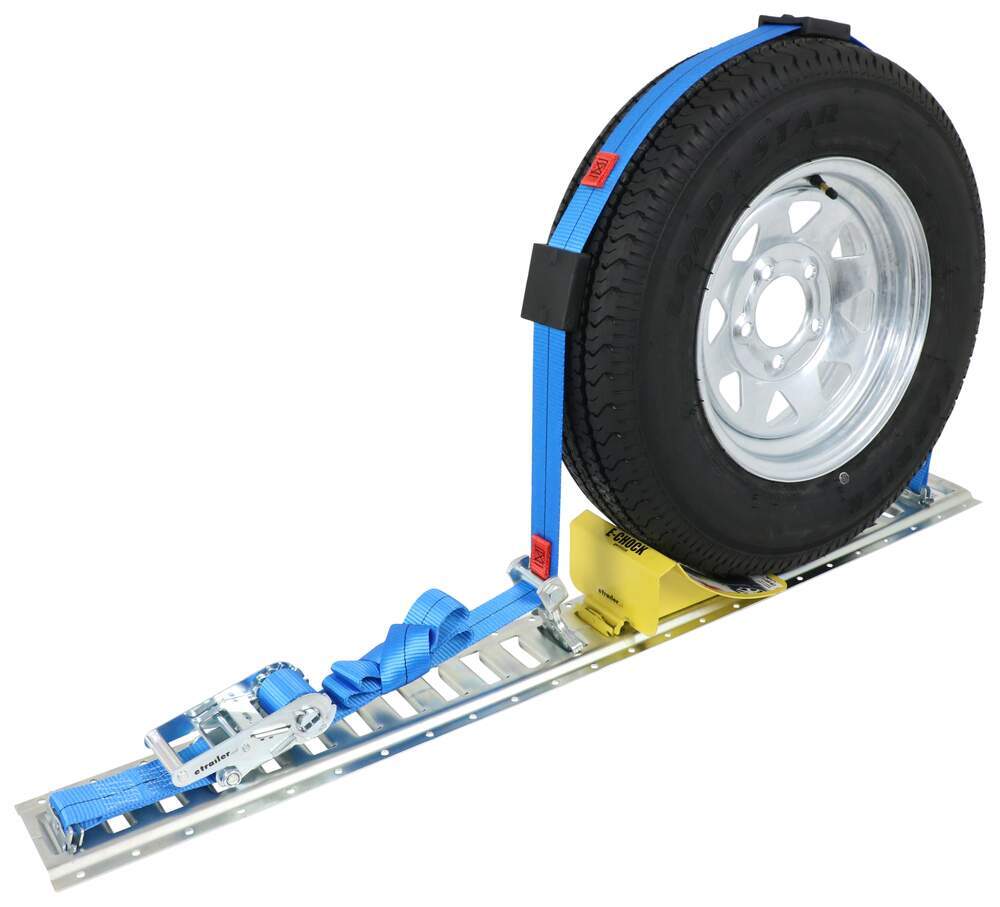
- The preferred method is to secure the vehicle by the wheels:
- Use straps over each wheel or approved wheel tie-downs
- No additional frame or body straps are required when properly secured by the wheels
- Ensure the parking brake is firmly set
- Turn off the main battery disconnect switch
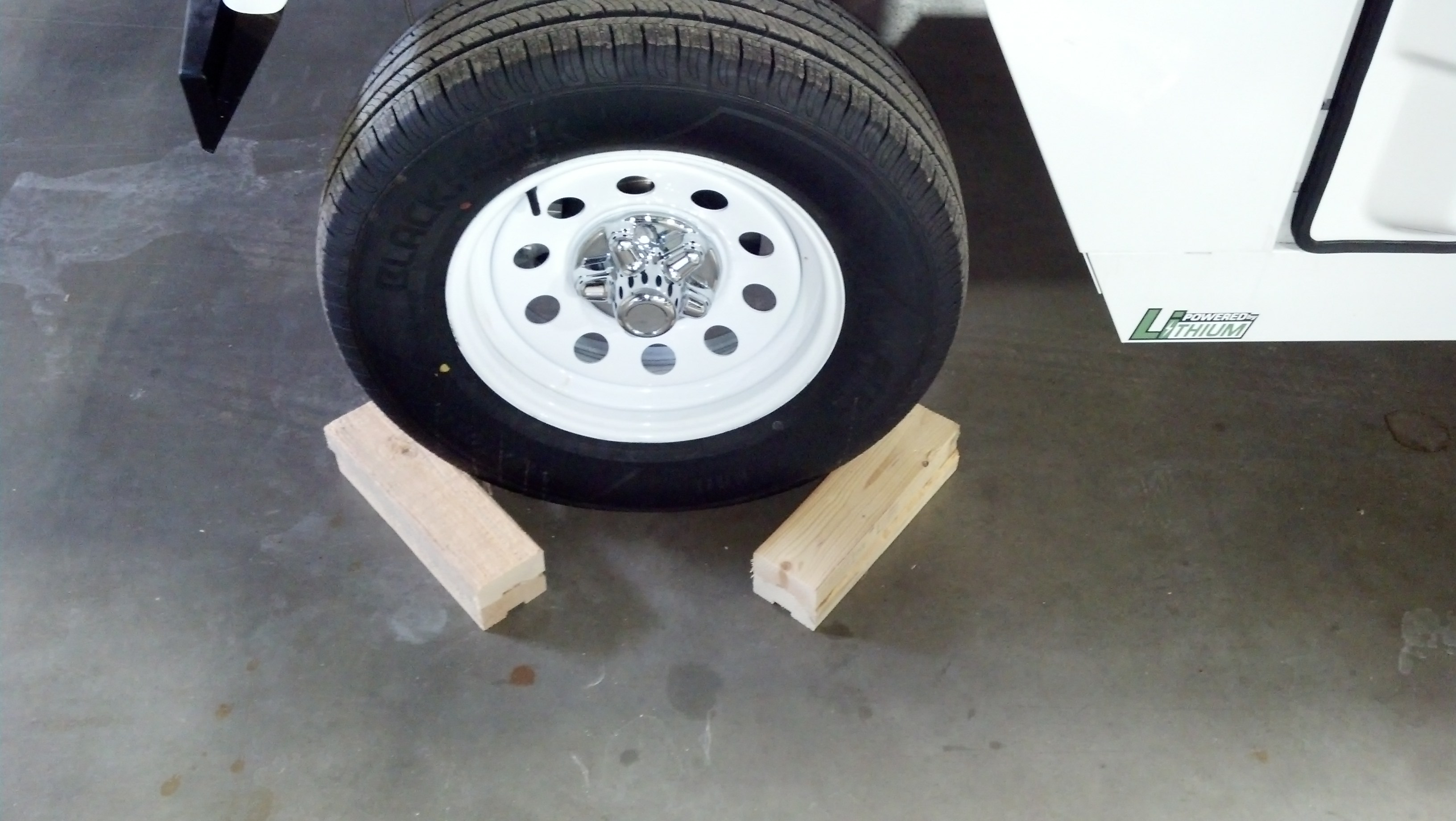
If the above method is not an option, the following method may be used for enclosed trailers only. This is the method we use to transport most new vehicles in a 53-foot enclosed semi-trailer.
- Materials Required: Quantity: 16 – wood blocks (2" x 4" x 16"), Quantity: 32 – 3" nails
Installation Instructions:
- The wood blocks should be nailed directly to the wood floor of the enclosed trailer.
- Position the blocks as shown in the reference image.
- Each position should use two stacked boards (two layers high flat against each other).
- Each board typically requires two 3" nails.
- Semi-trailer wood floors are very dense, so using a power nailer is recommended.
- Position the boards tightly against the tires:
- Start by placing one nail as a pivot point
- Press the board firmly against the tire
- Then install the second nail to secure it in place
This method prevents the vehicle from moving forward, backward, or side-to-side.
Important Notes:
- Ensure the parking brake is firmly set
- Turn off the main battery disconnect switch when transporting
- The trailer must have wood floors for this method to be used.
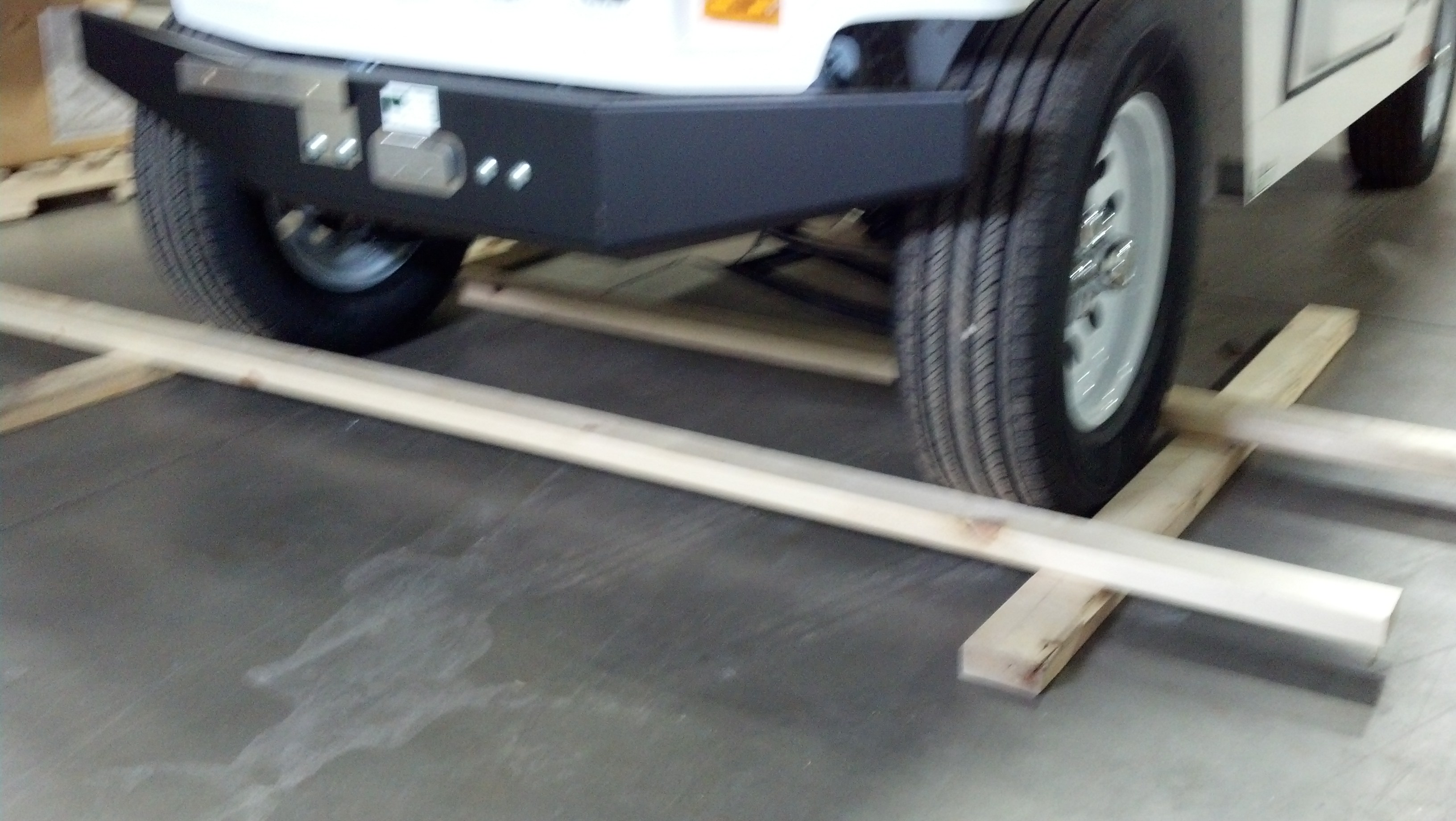
Some semi-trailers have steel plates on the floor of the front and/or rear of the trailer, if so, you will need these materials:
qty. 2 - 2 x 4 x 8-foot wood boards and qty. 2 - 2 x 4 x 5-foot wood boards. You will need to lay the 5-ft board length wise alongside the tire and nail it in place behind the steel plate. Then place one 8-foot board in front of the tire and other in rear of the tire. The 8-foot boards will stretch width wise contacting tire on each side as shown in the image below.
If none of the previously described methods are possible, the only remaining option we recommend is to strap the vehicle using the method described below.
· Ensure the parking brake is firmly set.
· Turn off the main battery disconnect switch.
Front of the Vehicle:
· It works best to strap to the lower A-arms in the center of the vehicle.
· Strap forward and outward from the vehicle so it cannot move backward or side-to-side.
Rear of the Vehicle:
· Hook the straps on the rear leaf spring, at the rear of the spring just before it mounts to the leaf spring shackle.
· Cross the rear straps:
o The left strap should pull the vehicle to the right and backward
o The right strap should pull the vehicle to the left and backward
· This configuration prevents the vehicle from moving forward or side-to-side.
Important Safety Notes:
· It is not recommended to strap to any other part of the vehicle.
· If you must strap elsewhere, ensure the straps do not contact painted surfaces, as they can rub and damage the paint.
· Do not strap against brake hoses or brake lines.